In the demanding environment of heavy industry, the reliability of fluid transfer systems is the backbone of production efficiency. From chemical processing to automated cooling lines, the demand for high-performance tubing has never been greater. Among the various solutions available, the Transparent Hose (Clear PVC Hose) stands out as a versatile and essential component. However, not all transparent hoses are created equal. For industrial engineers and B2B procurement managers, understanding the intersection of material science and mechanical performance is key.
This VinaFlex guide explores why transparent hoses are the preferred choice for modern factories and how to evaluate their performance for long-term industrial success.
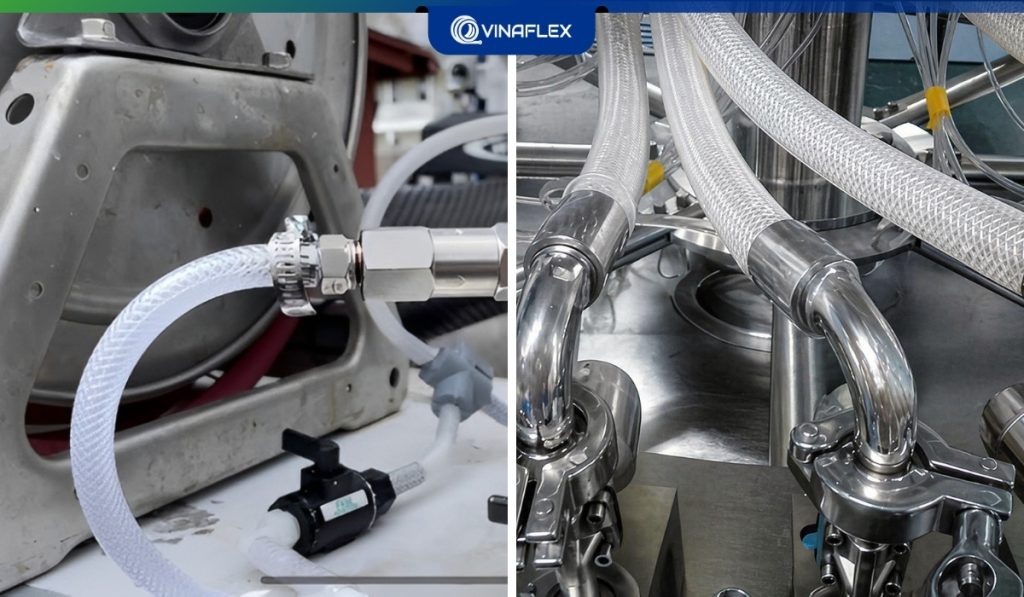
Table of Contents
What is a Transparent Hose?
Before diving into technical performance, we need to define the product. Transparent hoses, often referred to as clear PVC tubing, generally come in two structural variations to suit specific industrial requirements:
- Single-Layer, Unreinforced Hose: Extremely lightweight and flexible. It is ideal for low-pressure or gravity-feed applications, such as fluid transfer in food processing, pharmaceutical manufacturing, packaging, and laboratory environments.
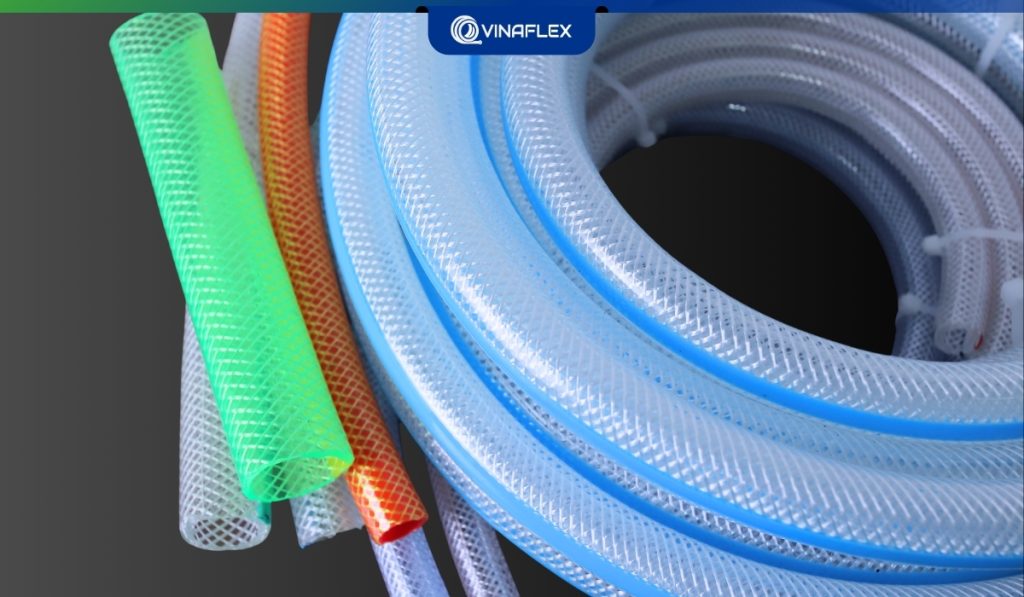
- 3-Ply Reinforced Hose: Featuring an internal high-density polyester mesh, this braided version is engineered for rigorous sectors. It safely handles the higher working pressures required in chemical processing, automated manufacturing, and heavy-duty pneumatic cooling lines.
Which is better for Heavy Industry?
While single-layer tubing is perfect for light-duty tasks, the 3-Ply Reinforced Transparent Hose is the definitive choice for heavy industrial applications. Its braided structure provides the essential burst resistance needed to handle sudden pressure spikes, vibration, and continuous mechanical stress on a busy factory floor.
Regardless of the structure, their most important feature is the crystal-clear wall, which provides an unobstructed view of the fluids passing through. In the following sections, we will break down exactly how this transparency, combined with robust material science, optimizes daily operations and reduces the Total Cost of Ownership (TCO) for factory managers.
1. Optimizing Operations via Visual Flow Monitoring
In an opaque piping system, a problem only becomes visible when it’s too late. The primary value proposition of a Transparent Hose is the “Real-time Insight” it provides into the heart of the machinery.
Immediate Troubleshooting and Risk Mitigation
Visual monitoring allows maintenance teams to identify issues that sensors might miss. For instance, the presence of air bubbles often signals a faulty seal or pump cavitation. In industries handling expensive or sensitive liquids, detecting discoloration or particulate contamination through a clear hose can prevent an entire batch from being ruined. This transparency transforms a simple hose into a diagnostic tool.
Enhancing Safety in High-Pressure Environments
Safety is paramount in heavy industry. By being able to see the fluid behavior, operators can spot blockages or sediment build-up before they lead to dangerous pressure spikes. This “pre-warning” system provided by high-clarity PVC tubing significantly reduces the risk of hose bursts and workplace accidents, ensuring a safer environment for the factory floor personnel.
2. Material Science: Industrial Chemical Resistance
Heavy industrial applications often involve contact with diverse substances. The performance of a Transparent Hose is dictated by the quality of the PVC compound used in its extrusion.
Resistance to Corrosive Agents
A premium clear PVC hose is formulated to withstand a variety of industrial chemicals, including diluted acids, alkalis, and various solvents. At VinaFlex, our hoses utilize high-purity PVC compounds that ensure the material does not degrade or become brittle when exposed to these substances. This chemical stability is vital for maintaining the purity of the medium being transferred and protecting the structural integrity of the hose itself.
Non-Toxic and Non-Leaching Properties
In industries such as food processing or pharmaceutical manufacturing (industrial grade), the hose must not contaminate the fluid. High-quality transparent hoses are engineered to be non-toxic and phthalate-free. VinaFlex’s commitment to international standards like REACH and RoHS ensures that our hoses do not leach harmful chemicals into the system, maintaining the highest levels of product integrity and regulatory compliance.
3. Durability and Lifespan: The Total Cost of Ownership (TCO)
For Industrial Distributors and OEMs, the initial price of a hose is only one part of the equation. The true cost is determined by its lifespan and the frequency of replacement.
Superior Abrasion and Impact Resistance
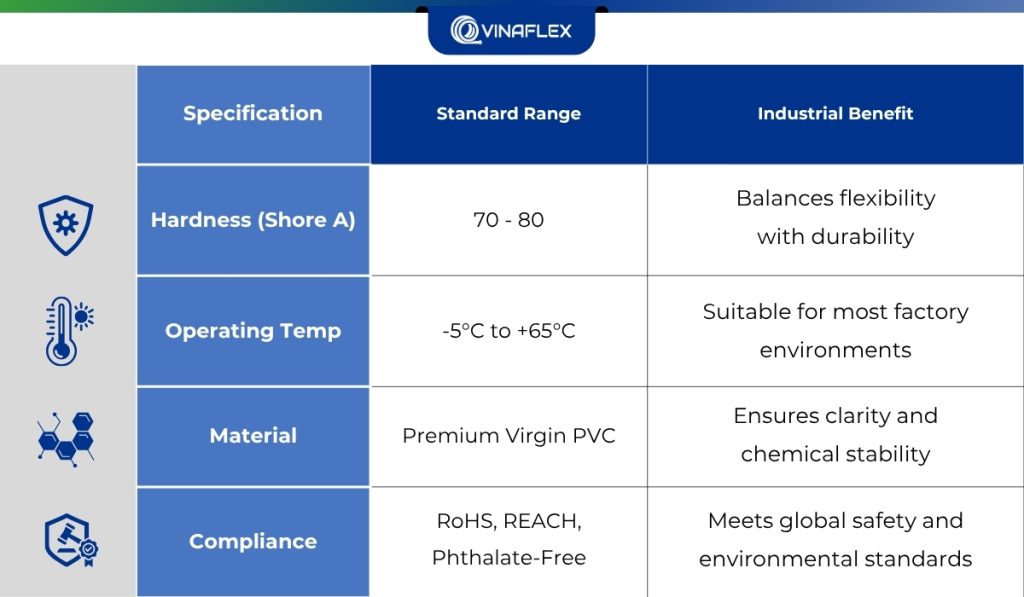
Heavy industry floors are brutal on equipment. Hoses are dragged across concrete, stepped on, and pinched by heavy machinery. A high-performance Transparent Hose must feature a robust exterior that resists scuffing and abrasion. VinaFlex hoses are designed with a specific Shore A hardness that balances flexibility with a “tough skin,” ensuring they can withstand the daily rigors of a busy factory floor without thinning or leaking.
Anti-Kinking and Flexibility Retention
A hose that kinks is a hose that fails. Kinking restricts flow, creates pressure points, and eventually leads to cracks. Advanced extrusion techniques allow us to produce clear PVC tubing that maintains its circular cross-section even when bent around tight machinery corners. This “memory” effect ensures consistent flow rates and extends the operational life of the hose by years, significantly lowering the Total Cost of Ownership for the end-user.
4. Technical Benchmarks: Pressure and Temperature
To select the right hose, one must look at the data. Performance is not subjective; it is measured in bars and degrees.
Operating within Temperature Thresholds
Most industrial-grade clear PVC hoses are designed for a temperature range of -5°C to 65°C (23°F to 149°F). It is critical to understand that as temperature increases, the pressure rating of the hose decreases. Operating outside these parameters can lead to “ballooning” (softening) in high heat or “shattering” (brittleness) in extreme cold.
Understanding Pressure Ratings
While transparent hoses are often used for gravity feed or low-pressure transfer, their “Burst Pressure” vs. “Working Pressure” ratio (typically 3:1) must be strictly observed.
Table 1: General Performance Specifications for VinaFlex Transparent Hoses
5. Why Source Directly from VinaFlex Vietnam?
In a competitive global market, the source of your industrial components is a strategic decision. VinaFlex offers more than just a product; we offer supply chain security.
Vertical Integration and Quality Control
As part of the Nhat Huy Group, VinaFlex benefits from an in-house PVC compound supply chain. This means we control the quality from the raw materials to the final extruded hose. Every meter of our Transparent Hose undergoes rigorous automated QC to ensure uniform wall thickness and zero defects. This vertical integration also allows us to offer premium quality that strictly complies with ISO 9001, RoHS, and REACH standards at highly competitive direct-manufacturer pricing.
Vietnam as a Strategic Sourcing Hub
Sourcing from Vietnam allows global vendors and distributors to diversify their supply chains and reduce reliance on traditional hubs. With modern infrastructure and favorable trade agreements, VinaFlex provides a stable, reliable, and high-capacity manufacturing partner capable of meeting large-scale OEM requirements for the most demanding heavy industry applications.
6. Conclusion
Choosing the right Transparent Hose is a critical decision that impacts factory safety, operational clarity, and long-term costs. By focusing on visual monitoring capabilities, chemical resistance, and technical durability, industrial leaders can ensure their fluid transfer systems are optimized for performance. VinaFlex remains committed to delivering premium clear PVC hoses and engineered tubing that meet the rigorous standards of heavy industry worldwide.
👉 Read full guide: The Engineering Guide to Transparent Hoses